
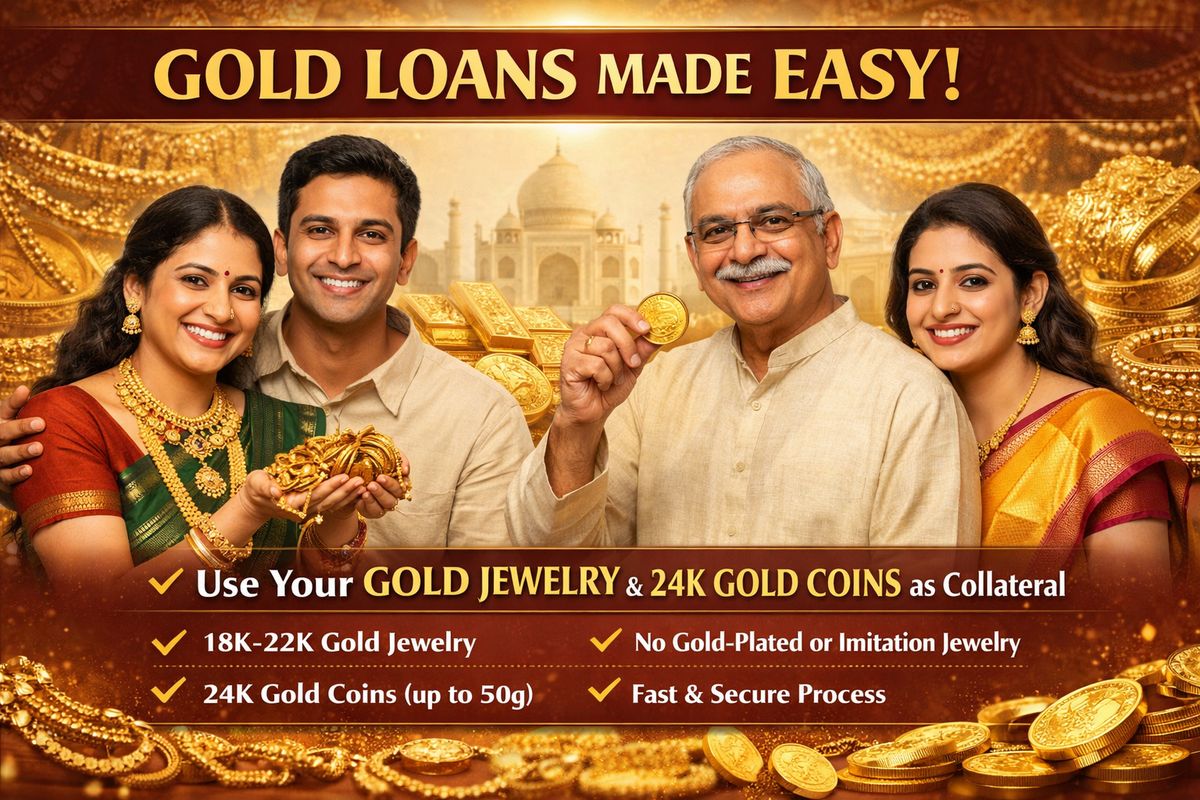
A gold-backed loan is a simple solution to access money by using your gold as collateral. A secured loan backed by your gold allows you to access the hidden cash value of your gold to fulfil personal or business needs, quickly, while also securely storing your valuable asset with a third-party company. The first step in a gold loan is knowing what specific types of gold items can be used for collateral to get the loan. Whether it is because of a medical emergency, educational expense, or developing your business, knowing if the gold you have is eligible will allow you to ensure the loan can be approved smoothly.
What Kinds of Gold Can Be Used As Collateral For A Loan?
Most financial institutions will accept various types of gold ornaments as collateral for a gold loan, but most institutions will only accept ornaments that are 18k - 22k in purity. Gold necklaces, bangles, chains, rings, earrings, and other traditional ornaments like mangalsutra and bracelet types are generally acceptable as collateral for a gold loan. Most lenders prefer to take household gold jewelry as collateral for a gold loan rather than investment-type gold jewelry because household gold jewelry is usually held for sentimental reasons, therefore reducing the likelihood of defaulting. There are some exclusions though, as most lenders will not accept gold-plated jewelry, costume jewelry or jewelry with too little gold content. Lenders will only consider the net gold weight of the items being used as collateral.
Gold Jewelry Used for Gold Loan: Purity & Eligibility Criteria
To determine if you qualify for a gold loan, lenders typically evaluate the purity of the gold that you are offering as collateral. Most lenders will only lend on gold jewelry that is at least 18K. Gold jewelry that is made with 18K - 22K of gold will be the most common required for a gold loan because it has the highest price per gram. Although 24K is considered pure gold, it is typically not used in jewelry since it is very malleable. Most individuals use 22K of gold (which is 91.6% pure) since they can sell their jewelry for a premium compared to the amount of gold contained in the piece. When assessing your collateral, a lender will deduct the weight of any non-gold items attached to your piece (for example, pearls, stones, etc.) before determining the net weight of the piece to calculate the total value of your collateral. To calculate the total value, simply multiply the net weight of the gold by the current spot price of gold.
Gold Loan Eligibility Criteria for Jeweler's
Minimum Purity Standards: Gold coins and gold bars must be a minimum of 18K or greater; anything below 18K will not qualify since it only contains 75% of the pure gold.
Quality of Items: Each item must be intact and not have been damaged due to being made of hollow designs or having missing links that would prevent accurate testing for purity.
Ownership of Items: Borrowers are required to show that they are the actual owner of the item(s) being pledged as collateral. If the item(s) have been inherited, a legal certificate of ownership must be provided to show proof of ownership.
Know Your Customer Compliance: The borrower is required to show valid identification and proof of address to complete an application for a gold loan.
Gold Assessment: The borrower must bring their jewelry into the branch where the gold will be evaluated by a trained and certified appraiser or valuer.
Can I Use Gold Coins or Bullion for Gold Loans?
While gold is mostly borrowed as jewelry, bullion may also be eligible for a loan based largely upon meeting strict regulations governing the types and sizes of bullion pieces that can be physically realized through state approved lenders. Bank issued gold coins (i.e. Sovereigns) and coins purchased from an established jeweler can be used for securing loans. Loans secured by coins must consist of only 24 karat gold and must not exceed 50 grams in total weight per customer. All coins must also carry some form of proof of purity or authenticity. Generally, gold bullion bars that meet the same requirements are not eligible for use as loan security due to the fact that bullion bars are classified as investment products rather than personal possessions. If a customer can provide additional certified coins as part of the loan security, then the customer may qualify for a higher loan-to-value (LTV) calculation, thus allowing the customer to receive a larger funded amount.
Gold Items That Are NOT Accepted for Gold Loans
There are common misconceptions about what kind of jewelry can be pledged as security for a gold loan. One of the most important points to understand is that the lender looks at the actual gold content of your pledge, rather than its sentimental or artistic value. Lenders will assess the purity and net weight of the gold that you are submitting for consideration under either a gold loan or other form of collateral in determining whether or not to approve your loan based on the value of the item.
If an item does not meet certain quality standards for purity, it may not be accepted by their process for determining its value; therefore, it will be rejected as not being eligible as collateral for a gold loan.
Typical Items that Are Rejected for Gold Loans Include:
Gold plated jewelry (a layer of gold applied to another metal, such as copper, or other materials) will not be accepted for gold loans
Gold imitation/false or "white gold" jewelry will not be accepted
Jewelry that has a large number of heavy stones attached that makes up the bulk of the total weight will be accepted for a gold loan only if the balance of the weight exceeds the minimum lending limit
Items made of industrial quality gold, extremely ornate deities made from gold, worth their value based on craftsmanship, and items made from historical gold (e.g., ancient Egyptian artifacts), will likely not be accepted for a gold loan
Jewelry that does not meet the minimum karat requirement (generally 30 karats) will not be accepted for gold loans.
How A Service Provider Determines The Amount of A Gold Loan By Evaluating The Type Of Jewelry Used To Secure It
Non eligible items will decrease the total appraisal value for your overall pledge made through the use of the item as security for gold loans; consequently, if the item does not meet the minimum eligibility standards, the gold loan process will only approve you for an amount that is only a portion of the total value of the gold that you have loaned against.
When getting a gold loan, the total weight of your items is not the only thing that determines the final sanctioned amount, as the type of jewelry that you use for collateral will play a major role. Lenders use a detailed methodology to calculate the final value based on the individual characteristics of the jewelry. This includes the value of gold itself, with its net weight after removing stones, the method used to test for purity (for example, using a karat meter), and the current market price per gram of gold. The jewelry must also be in good condition; not broken, and cannot be hollow or have any other defect; otherwise, your credit limit may be reduced based on the LTV ratio (Loan-to-Value) of 75% of the final value of the gold loan.
Things that will affect the value of your gold loan are:
More Purity = More Loan Amount - You will get more for the same amount of gold if it is 22K than 18K.
Lightweight/Hollow Jewelry = Low Value - Lightweight or hollow jewelry has a lower net weight of gold than appears to be there.
Heavy Stone Value = Low Value - Stones that weigh down the jewelry will not be included in the total weight of gold.
Certified Coins - Certified coins are much easier to appraise because they have a certificate of fineness, which guarantees their value.
FAQs
1.Question: Is 18K gold considered jewelry for a gold loan?
Answer: For most lenders, 18K is the minimum purity standard for jewelry that can be used as collateral in a gold loan. Jewelry, regardless of its purity, can be loaned at a much lower per gram rate than 22K jewelry. Once the purity of the gold is established, you can obtain a gold loan with little-to-no documentation and excellent interest rates.*
2.Question: Are gold coins considered jewelry for a gold loan?
Answer: Gold coins fall into a different category than jewelry, however, you may still obtain a gold loan with a gold coin as collateral. 24K gold coins weighing less than 50 grams can be used for all other types of gold loans; however, the majority of loans are issued against jewelry.
3.Question: Will having stones affect the amount I can borrow?
Answer: Yes, when appraising jewelry for a gold loan, lenders examine the purity of the gold on its own merit. The total weight of the stones, pearls, or gemstones will be deducted from the total weight of the jewelry. Therefore, the amount you will receive for your gold loan will reflect only the net weight of gold; thus, your appraisal will be transparent.
Question 4 - Can I use my old and damaged jewelry as collateral for a loan to get cash against it?
Answer: Yes, the appearance of your jewelry used as collateral is not as vital as the weight and purity of the gold within it. You can pledge any item of gold, even if it is broken (due to the clasp or the gold bangle is bent) or missing stones, if the gold content of the item is between 18k and 22k.
Question 5 - Do I need a certain amount of jewelry for my application to be processed?
Answer: A number of lenders require a minimum amount (commonly around two grams) of actual (as opposed to total) gold within your piece of jewelry before they will process your loan request. Minimum amounts a lender will accept depend on who your lender is.
Question 6 - If I inherited my jewelry, may I use it to get a gold loan?
Answer: Yes, if you inherited your jewelry, you may use your inheritance as collateral for a loan. If the jewelry was willed to you, you will need a copy of your KYC documents, and any supporting legal documents proving your inherited status as the owner of the jewelry. The jewelry must be free of any disputes between the estate of the deceased.
Question 7 - Is there a difference between bars of gold and jewelry when using them as collateral for a gold loan?
Answer: Yes, generally, many financial institutions will impose limitations on the use of gold bars as collateral for a gold loan when compared to the use of processed jewelry as collateral. Gold bars are often regarded as commercial bullion.
Ready to compare real offers?
One application. 10+ RBI-registered lenders. Free for borrowers.